Total Lunar Eclipse on March 3, 2026 will be visible in India during evening hours with key phases in the late afternoon and early evening

Total Lunar Eclipse March 3 2026 will take place on Tuesday. This event happens when the full Moon passes completely into Earth’s umbral shadow. It creates a striking view as the Moon often appears reddish.The total lunar eclipse has a magnitude of 1.155. This makes it a deep total eclipse. The event will be visible in many regions. These include India, Eastern Asia, Australia, and the Americas.
In India, visibility depends on location. Most places will see the ending phase of the lunar eclipse around moonrise. Some areas in North-East India and the Andaman and Nicobar Islands will also see the end of the totality phase.Key Timings (IST) for the Total Lunar Eclipse March 3 2026 are as follows. The eclipse begins at 15:20 (3:20 PM). Totality starts at 16:34 (4:34 PM). Totality ends at 17:33 (5:33 PM). The eclipse ends at 18:48 (6:48 PM).
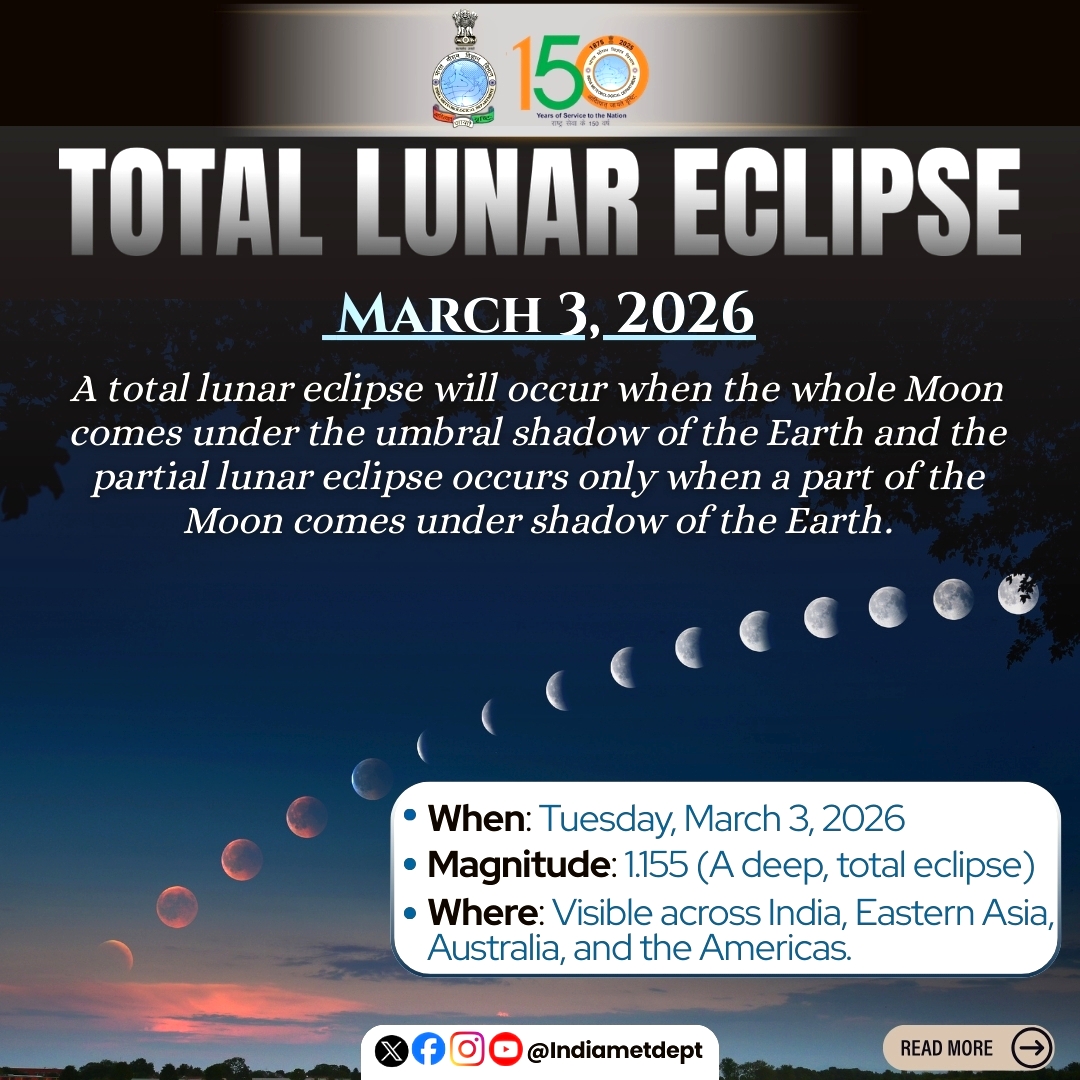
A total lunar eclipse occurs when the entire Moon enters the Earth’s dark umbral shadow. A partial lunar eclipse happens when only part of the Moon enters this shadow. During totality, the Moon can take on a copper or red color due to sunlight refracted through Earth’s atmosphere.People in India should look for the Moon in the eastern sky during the evening. In most cities, the later stages will be visible after sunset when the Moon rises. No special equipment is needed to view this event. Safe viewing is possible with the naked eye.
The Total Lunar Eclipse March 3 2026 offers a good chance for skywatchers. Residents across the country can observe this natural phenomenon from home or open areas. Check local weather for clear skies to get the best view.
This eclipse marks an important astronomical event in 2026. It provides an opportunity to see one of nature’s impressive displays without any risk.

Lunar eclipse:
A lunar eclipse happens when Earth sits directly between the Sun and the Moon. This alignment causes Earth’s shadow to fall on the Moon. It only occurs during a full Moon phase.The Moon orbits Earth, but its path is tilted about 5 degrees compared to Earth’s orbit around the Sun. This tilt means the Sun, Earth, and Moon do not line up perfectly every month. Eclipses happen only when the alignment is close enough at one of the orbital nodes.
Earth casts two main parts of its shadow on the Moon:
The umbra is the dark central cone where direct sunlight is completely blocked.
The penumbra is the outer, lighter shadow where sunlight is only partly blocked.
There are three main types of lunar eclipses:
Penumbral lunar eclipse — The Moon passes only through the penumbra. It looks slightly dimmer, but the change is often hard to notice.
Partial lunar eclipse — Part of the Moon enters the umbra. A dark “bite” appears on the Moon.
Total lunar eclipse — The entire Moon enters the umbra. This is the most dramatic type.
In a total lunar eclipse, the Moon does not disappear. It turns red or orange — often called a “blood moon.” This happens because sunlight still reaches the Moon indirectly.
Sunlight passes through Earth’s atmosphere around the edges of the planet. The atmosphere scatters shorter blue and violet wavelengths (Rayleigh scattering), the same effect that makes the sky blue and sunsets red. Longer red and orange wavelengths bend (refract) into the umbra and light up the Moon.
The result looks like every sunrise and sunset on Earth is projected onto the Moon at once. The exact shade of red depends on atmospheric conditions like dust, clouds, or volcanic ash.
Read More: Khamenei Killed in US-Israel Strikes on Iran